
Skip to content
✓ Verified quality
Contact support →
⚕ Physician recommendation required · Educational information, not medical advice
Dripfy
≥99% HPLCPre-filled pen

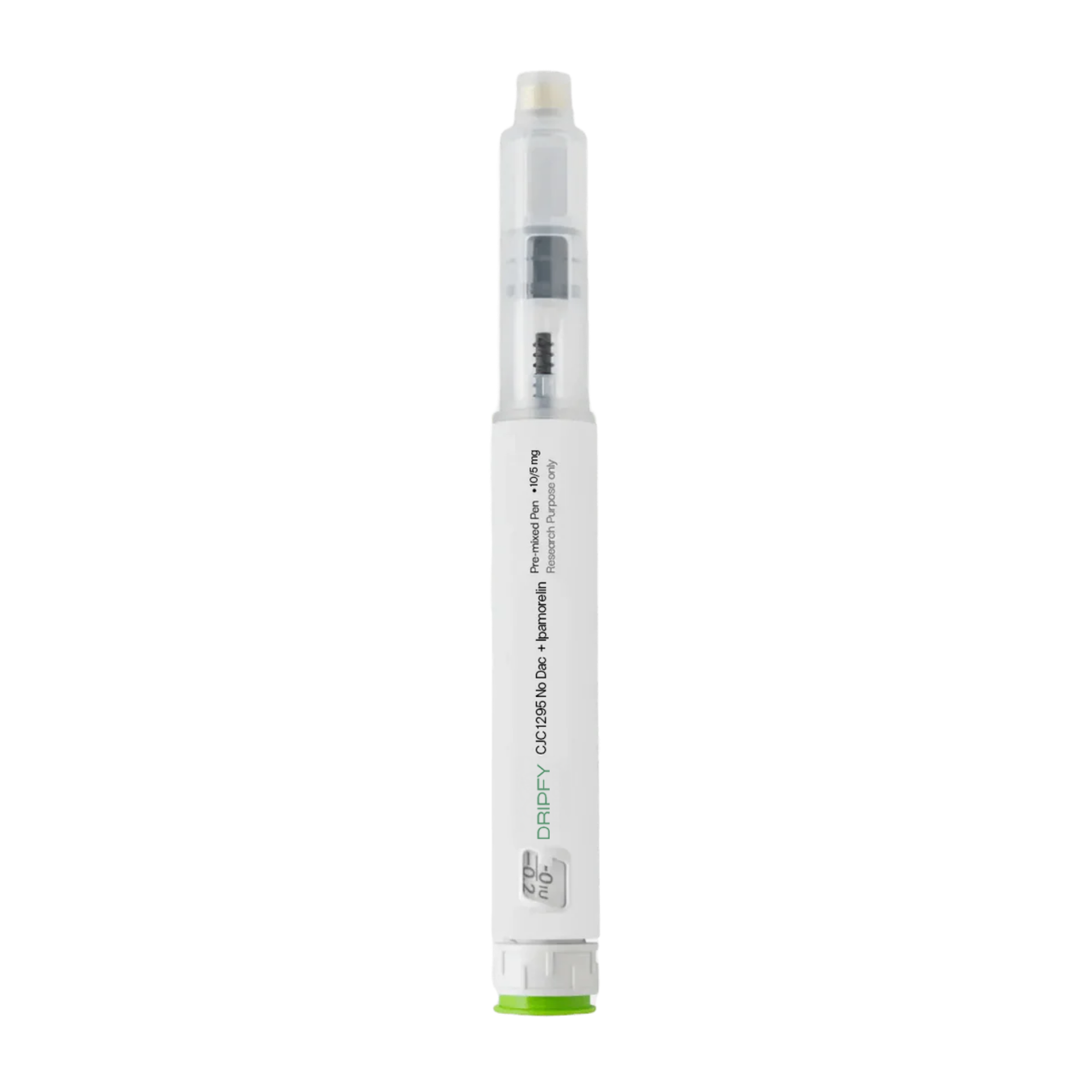
CJC-1295 (no DAC)

What it is?

CJC-1295 (no DAC), also known as Mod-GRF 1-29, is a short-acting, research-grade analog of growth-hormone-releasing hormone (GHRH). It belongs to the GHRH-analog family and is studied for its influence on the growth-hormone / IGF-1 axis; it is not an approved medicine.

Dripfy Advantage

  • GHRH-receptor pathway: understood to engage pituitary GHRH receptors and prompt pulsatile growth-hormone release.
  • Short-acting profile: without the Drug Affinity Complex (DAC), its action is brief, so it is investigated as a pulse secretagogue rather than a sustained one.
  • IGF-1 axis signalling: may influence downstream IGF-1 signalling as part of the same axis.
  • Physician-directed: Any regimen is determined solely by the supervising physician.

Research & Investigational Focus

  • GH / IGF-1 support: investigated for growth-hormone and IGF-1 axis support.
  • Lean-mass & recovery: studied within lean-mass and recovery research contexts.
  • Body composition & sleep: explored for body-composition and sleep-quality signalling.

Composition & Formulation

  • Format: Pre-filled pen
  • Purity: ≥99% by HPLC/MS
  • Supervision: Physician-directed use only
€496

Submit an enquiry and we arrange the consultation, physician review and shipping. Physician recommendation required; not medical advice.

Purity
≥99%
Form
Pre-filled pen
Download Certificate of Analysis
Certificate of Analysis available on request

Important medical notice

  • A physician recommendation is mandatory before use.
  • The information on this website is educational only and is not medical advice, diagnosis, or treatment.
  • Always consult a qualified physician before starting any peptide.
  • Dosing is individualised and determined by your treating physician.

Peptide Practice Guide

Each card summarises what the peptide is studied for and its evidence strength. It is not a recommendation. Dosing and suitability are decided by your physician.

CJC-1295 (no DAC)

GHRH analog (investigational) · Pre-filled pen

D· Preliminary evidence

CJC-1295 without DAC (Mod-GRF 1-29) is a modified fragment of growth-hormone-releasing hormone. It is understood to bind GHRH receptors on the anterior pituitary and to prompt pulsatile release of endogenous growth hormone, which may in turn influence IGF-1 signalling. Without the Drug Affinity Complex its action is short-lived, so it is investigated as a pulse secretagogue rather than a sustained one. Human evidence remains limited and the mechanism is drawn largely from GHRH-analog research.

Studied use areas

  • Investigated for growth-hormone / IGF-1 axis support
  • Studied within lean-mass and recovery research
  • Explored for body-composition and sleep-quality signalling
  • Researched alongside other GH secretagogues in the GH-axis literature

Safety & status

  • Investigational; robust human safety data are limited
  • Use only under qualified physician supervision
  • Prohibited in competitive sport: listed under WADA Prohibited List class S2 (peptide hormones, growth factors, related substances and mimetics — GHRH analogues, where CJC-1295 is named)
  • Not for use in pregnancy or breastfeeding, or with active or suspected malignancy (GH/IGF-1 axis considerations)

⚕ Clinical note: CJC-1295 (no DAC) is an investigational, research-grade peptide and not an approved medicine. It is intended for physician-directed use only, and this content is educational, not medical advice.

Evidence: Grade D — investigational; essentially no peer-reviewed human data for the no-DAC form (evidence extrapolated from GHRH-analogue research) · References: Jetté et al., Endocrinology 2005 (origin of the tetrasubstituted GRF(1-29) backbone; the study itself characterises the albumin-binding DAC conjugate in rats); Teichman et al., Journal of Clinical Endocrinology & Metabolism 2006 (CJC-1295 with DAC — related long-acting analogue, not this product); Dominikowski et al., Frontiers in Endocrinology 2026 (evidence review of GH-axis peptides); Sigalos & Pastuszak, Sexual Medicine Reviews 2018
Related peptides