
Skip to content
✓ Verified quality
Contact support →
⚕ Physician recommendation required · Educational information, not medical advice
Dripfy
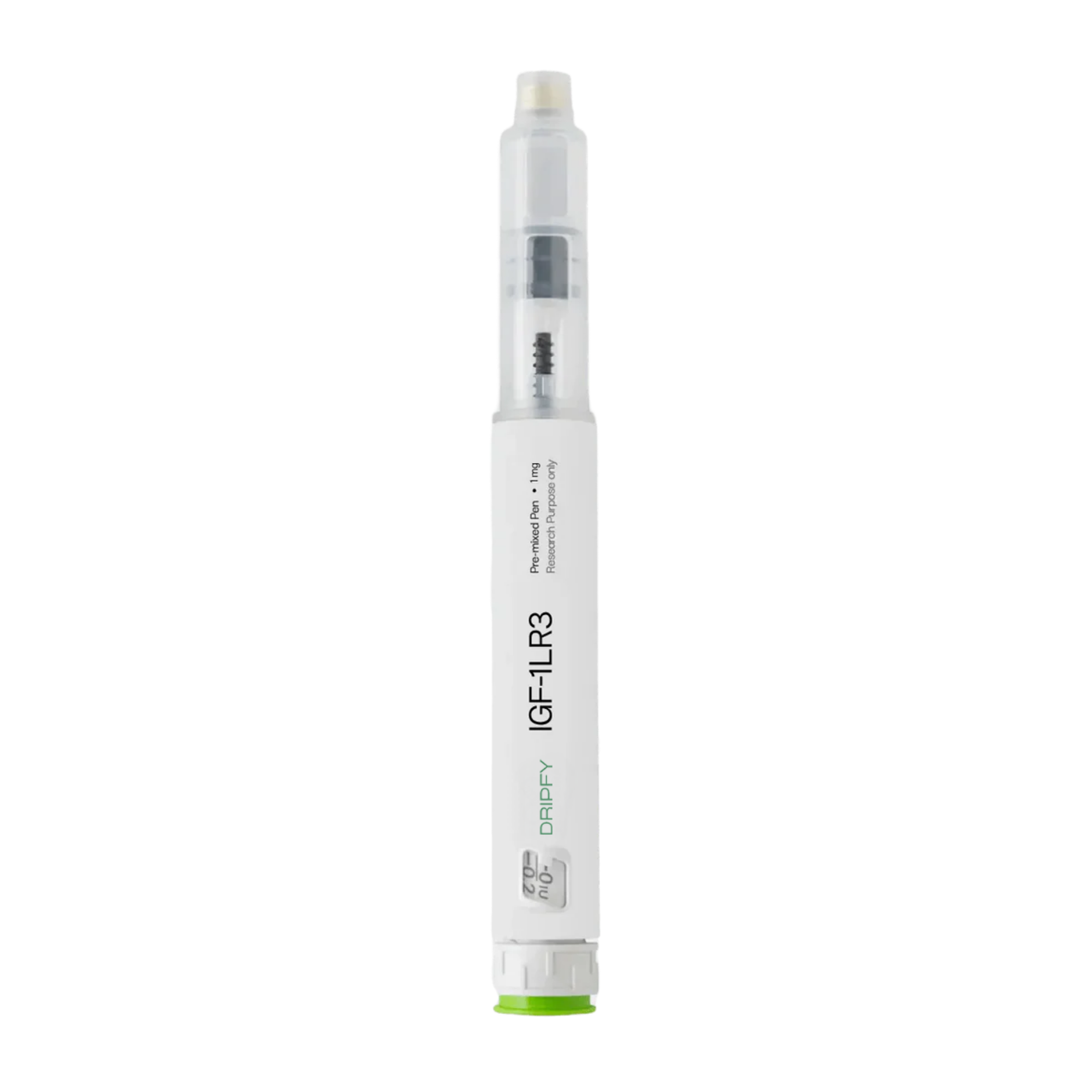
IGF-1 LR3 (Insulin-Like Growth Factor-1, Long R3)
≥99% HPLCPre-filled pen

IGF-1 LR3 (Insulin-Like Growth Factor-1, Long R3)

What it is?

IGF-1 LR3 (Long R3 IGF-1) is a modified IGF-1 analogue — human IGF-1 with an arginine substitution at position 3 and a 13-amino-acid N-terminal extension — studied for its role in cell growth, repair signalling, and anabolic pathway activation. Its modified structure markedly reduces binding to IGF-binding proteins, increasing its free, biologically active fraction and potency compared with native IGF-1 (despite faster plasma clearance); it is investigational and not an approved medicine.

Dripfy Advantage

  • Receptor engagement: Binds to IGF-1 receptors (IGF-1R) to initiate anabolic signalling cascades.
  • Signal transduction: Supports downstream pathways commonly linked to growth and adaptation, including PI3K/AKT/mTOR and MAPK signalling.
  • Protein turnover effects: Shifts cellular signalling toward increased protein synthesis and improved muscle maintenance dynamics.
  • Recovery signalling: Associated with myoblast differentiation and repair-related processes following training-induced microdamage.
  • Increased free-fraction profile: Modified structure is positioned to reduce binding to IGF-binding proteins, increasing the free, biologically active fraction and potency in research settings (it is cleared from plasma faster than native IGF-1, not more slowly).

Clinical Applications & Therapeutic Potential

  • Anabolic signalling support: Upregulation of pathways associated with muscle hypertrophy and adaptation via IGF-1R downstream signalling.
  • Protein turnover modulation: Increased protein synthesis signalling with a concurrent shift in proteolysis-related markers.
  • Regeneration & recovery dynamics: Support for satellite-cell activity and muscle-fibre repair signalling following mechanical stress.
  • Performance adaptation markers: Potential support for training-load tolerance through recovery kinetics (preclinical rationale; not established in humans).

Composition & Formulation

  • Peptide content: 1 mg IGF-1 LR3
  • Vehicle: Proprietary pH-balanced buffer solution
  • Delivery system: Pre-filled, multi-dose, closed-system pen
  • Total volume: 3 mL
  • Purity: ≥99% by HPLC/MS
€496

Submit an enquiry and we arrange the consultation, physician review and shipping. Physician recommendation required; not medical advice.

Purity
≥99%
Form
Pre-filled pen
Download Certificate of Analysis
Certificate of Analysis available on request

Important medical notice

  • A physician recommendation is mandatory before use.
  • The information on this website is educational only and is not medical advice, diagnosis, or treatment.
  • Always consult a qualified physician before starting any peptide.
  • Dosing is individualised and determined by your treating physician.

Peptide Practice Guide

Each card summarises what the peptide is studied for and its evidence strength. It is not a recommendation. Dosing and suitability are decided by your physician.

IGF-1 LR3 (Insulin-Like Growth Factor-1, Long R3)

Modified insulin-like growth factor-1 (IGF-1) analogue with reduced IGF-binding-protein affinity (investigational) · Pre-filled pen

D· Preliminary evidence

IGF-1 LR3 (Long R3 IGF-1) is a structurally modified analogue of IGF-1 — an arginine substitution at position 3 plus a 13-amino-acid N-terminal extension — that engages the IGF-1 receptor (IGF-1R) and downstream anabolic cascades such as PI3K/AKT/mTOR and MAPK. Its modified structure markedly lowers binding to IGF-binding proteins, which increases its free, biologically available fraction and potency relative to native IGF-1, although in animal studies it is cleared from plasma faster, not more slowly. Evidence for muscle or performance use is very limited and comes mainly from preclinical work.

Studied use areas

  • Research into anabolic and protein-synthesis signalling
  • Muscle repair and recovery research after training-induced microdamage
  • Cell growth, differentiation and tissue-adaptation research
  • Body-composition research alongside GH-axis pathways

Safety & status

  • Educational information only — not medical advice; use requires physician supervision
  • Investigational and not approved for muscle-building or performance; evidence is largely preclinical
  • Potent growth-factor signalling can affect blood glucose (hypoglycaemia risk) and involves proliferative pathways that need clinical oversight
  • Prohibited in competitive sport: listed under WADA Prohibited List class S2 (peptide hormones, growth factors, related substances and mimetics — IGF-1 and its analogues)
  • Screening, suitability and any monitoring are determined by the treating physician

⚕ Clinical note: This card is educational and is not medical advice, a protocol or a promise of results. IGF-1 LR3 is investigational; any use must be individualised and supervised by a qualified physician.

Evidence: Investigational (Grade D) — no peer-reviewed human studies; evidence is preclinical (cell and animal data) · References: Francis et al., Journal of Molecular Endocrinology 1992; Tomas et al., Journal of Endocrinology 1993; Bastian et al., Journal of Endocrinology 1993; Dominikowski et al., Frontiers in Endocrinology 2026
Related peptides